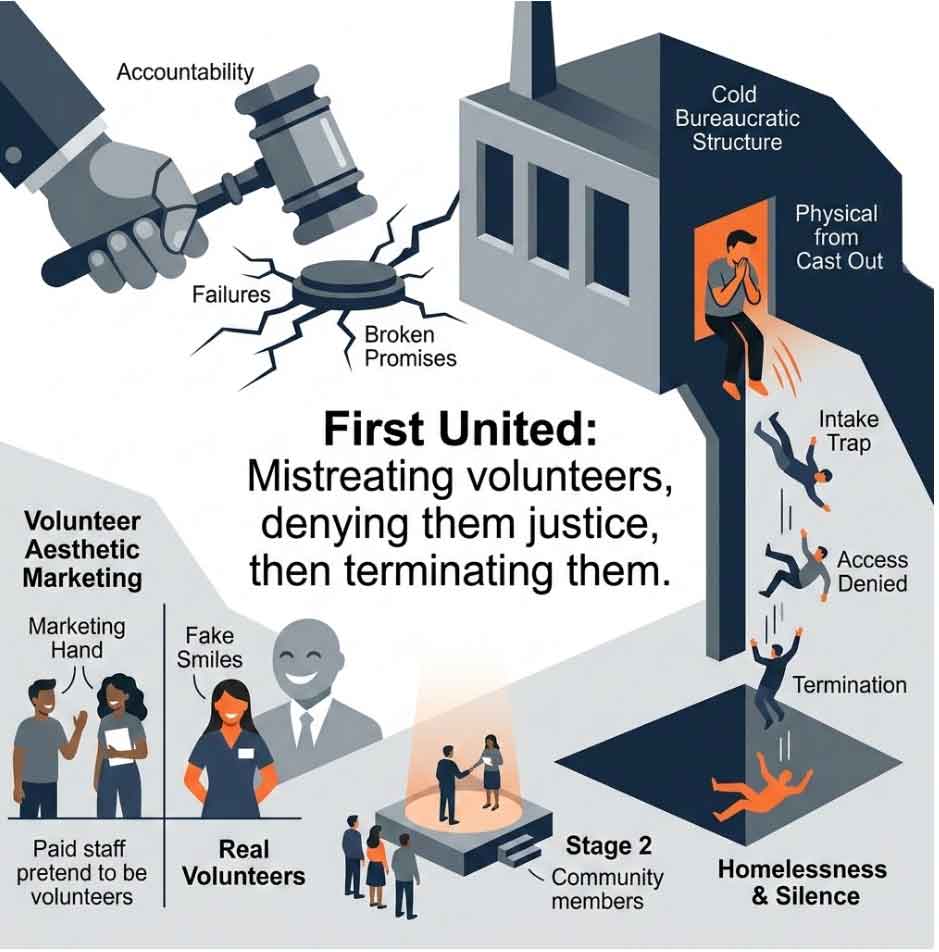
First United Church Community Ministry Society, operating in the heart of Vancouver’s Downtown Eastside (DTES), publicly positions itself as an unyielding champion of “dignity, belonging, and justice” [8]. On its website and in promotional materials, the organization boasts of its “low-barrier” services and campaigns, claiming that its core mission is to help vulnerable community members resolve crises, navigate systemic barriers, and remain securely housed [8].
Yet, beneath this carefully curated and highly polished public relations exterior lies a staggering culture of institutional coldness, bureaucratic bad faith, rapid retaliation, and blatant marketing deception [3, 7].
This is the definitive, investigative account of how First United’s leadership abandoned Johnny Zakharia—a disabled, low-income tenant and a dedicated volunteer who served the organization for over a decade—at the height of a catastrophic personal eviction crisis [3, 5, 65, 80]. It is a case study in institutional hypocrisy, detailing how an organization that collects millions in donations faked its volunteer marketing materials using paid staff members because they “didn’t have time” to find real volunteers [8], and then weaponized its internal policies to terminate a long-serving volunteer who dared to call out their failures [83, 92].

1. A Decade of Service Met with an Intake Trap
For over ten years, Johnny Zakharia was an integral part of the fabric of First United [65]. In 2026 alone, he contributed 42 volunteer hours across 30 separate assignments, performing intensive administrative support, help-desk services, meal service in the dining hall, wayfinding, and advocacy intake support [65]. His service extended back years, including serving on the front lines during freezing winter conditions to hand out hot chocolate to unhoused community members [65, 66].
Johnny volunteered because, as a person living with a disability and surviving on low-income assistance, he knew firsthand the vital role that community services play in the DTES [5, 65].
In the summer of 2026, the crisis arrived at Johnny’s own door. Following a disputed rental subsidy review, his non-profit housing provider demanded his monthly rent suddenly jump from $340 to $1,545 [5, 80]. On July 27, 2026, Johnny was served with a 10-Day Notice to End Tenancy, threatening him with immediate homelessness after 13 years in his home [5, 65]. Under British Columbia’s strict tenancy laws, Johnny had a narrow window to file a dispute; his absolute final filing deadline was August 4, 2026 [65].
Desperate and terrified, Johnny turned to First United’s Legal Advocacy Clinic [65]. The intake process, however, became a devastating trap:
- Document Gathering: Prior to his scheduled appointment, First United staff requested and collected Johnny’s highly sensitive, private tenancy agreements and landlord correspondence [14, 65, 70].
- The Deadline Trap: First United scheduled his substantive legal appointment for August 4, 2026—the absolute final day of his dispute-filing period [14, 65].
- The Sudden Denial: When Johnny arrived at the clinic on August 4, with only hours remaining before his housing security was legally forfeited, staff informed him for the first time that because he was a volunteer, he was categorically excluded from accessing advocacy services [14, 65].
With his housing security in immediate jeopardy, Johnny was turned away [7, 65]. He was forced to scramble, draft, and file his Residential Tenancy Branch (RTB) dispute application entirely on his own under extreme psychological distress [65, 66]. While Johnny managed to protect his RTB deadline through his own frantic efforts, First United’s intake failure exposed a vulnerable disabled volunteer to catastrophic, unnecessary risk [11, 65, 66].

2. Michelle Beda’s Written Refusal of Public Information
Recognizing that formal legal representation might raise legitimate conflict-of-interest concerns, Johnny sought to salvage his trust in the organization [4, 19]. On August 10, 2026, he sent a narrow, written follow-up to Michelle Beda, First United’s Advocacy Manager, asking:
“Can I get general information if I ever ask questions? Of course, you’re not representing me when you give me general information.” [40, 117]
On August 11, 2026, Beda issued a written refusal that laid bare the heartless breadth of First United’s volunteer-exclusion policy:
“Volunteers are precluded from accessing any services provided by First United for the community, including advocacy, so I’m sorry to say we are not able to provide legal information, either.” [3, 40, 117]
This statement was not a standard legal conflict screen; it was a sweeping, absolute ban [4, 7]. According to Advocacy Manager Michelle Beda, by donating his labor to First United, Johnny had effectively disqualified himself from the entire community safety net [3, 4]. Under this interpretation, a volunteer facing an emergency is barred from receiving even general, neutral legal information, public educational brochures, or basic procedural referrals [4, 19, 123].

3. The Visual Deception: Paid Staff Faking “Volunteer Appreciation”
The profound hypocrisy of First United’s leadership is perhaps most starkly illustrated by how they represent volunteers to the public and to donors [8]. The society’s marketing campaigns regularly feature emotional, highly produced volunteer appreciation posts, using images of smiling faces to build a brand of community warmth and attract fundraising dollars [8, 9].
However, when it came to their visual marketing, First United’s leadership engaged in a deliberate, manipulative deception.
Rather than taking the time to photograph real volunteers, First United used pictures of their own paid staff members, posing and pretending to be volunteers. They did this calculating that donors and members of the public would never know the difference.
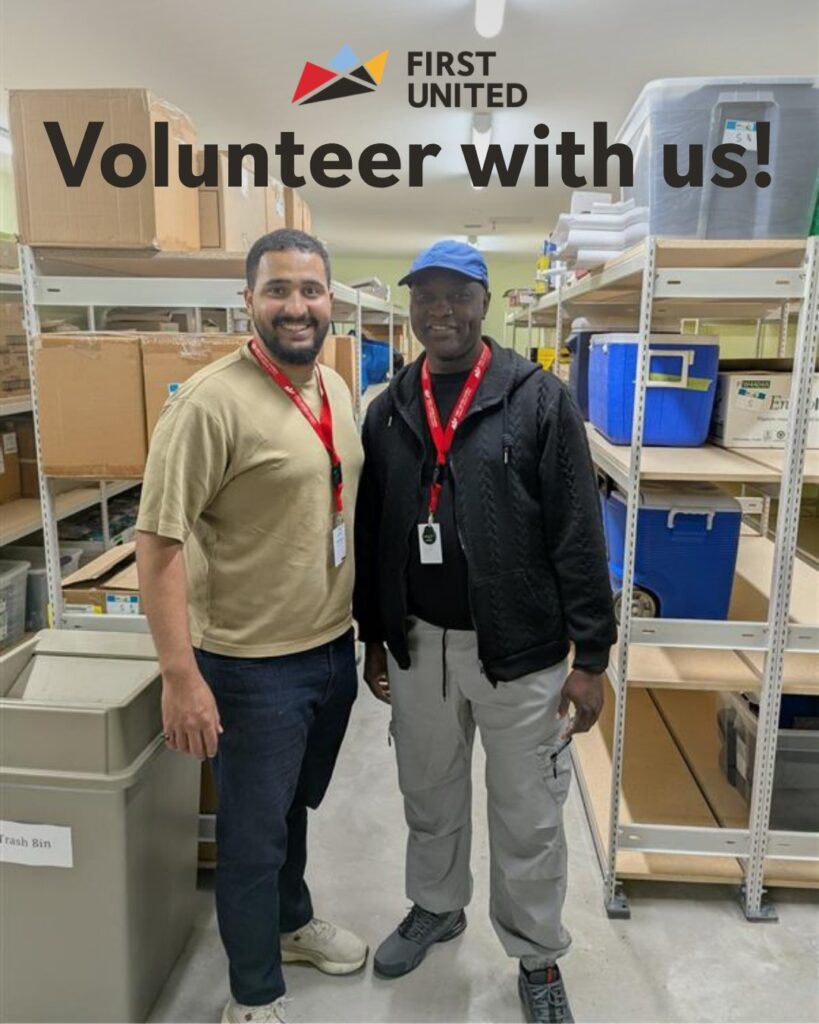
Johnny Zakharia—who had been on-site for a decade and knew every employee by name—immediately recognized the faces in the promotional photos. They were paid staff members, not volunteers. When Johnny called out leadership for faking their volunteer base, the organization’s response was a stunning admission of laziness, carelessness, and complete disregard for the truth:
“Well all, sorry about that. We just didn’t have time to find a picture of volunteers.”
This lame excuse was issued by a charity that has hundreds of photos of real volunteers on file. They simply did not care enough to use them. For First United’s administration, volunteers are not real humans deserving of protection and dignity; they are a visual aesthetic, a fundraising tool to be fabricated using paid staff models while the real volunteers are actively turned away in their moment of deepest crisis.
4. The Sabbatical Escape and the Bureaucratic Stonewall
On August 13, 2026, Johnny submitted a formal service and policy complaint under First United’s Complaints Policy [17, 39]. He requested a separate “service complaint” assessment regarding the timing and handling of his intake (collecting his documents and waiting until the final filing deadline to deny him help) and a “policy complaint” regarding the extreme breadth of Beda’s blanket exclusion [17, 39].
The response from senior leadership was a masterclass in institutional stonewalling and buck-passing:
- Executive Director Amanda Burrows: On August 18, 2026, Burrows formally received the complaint [22]. Instead of addressing the massive timing and intake failure, she unilaterally classified the entire submission as a “non-service” complaint to avoid a formal service-handling review [22, 114]. She then signed off with “wishing you well” and immediately departed on sabbatical, escaping any further accountability [22].
- Acting Co-Executive Director Katie Bricknell Koncan: On August 31, 2026, Koncan issued a highly dismissive response [24, 47]. While admitting that the scheduling was a “miscommunication on our end,” she declared the entire matter closed [26, 49].
To justify their cold treatment, Koncan quoted the Volunteer Handbook page 18 (“Volunteer Use of Society Resources”), claiming that the policy strictly forbade volunteers from accessing services [24, 48]. However, Johnny immediately reviewed the handbook and exposed a massive lie in the administration’s defense [27, 50].
5. Exposing the Lie: The Hidden Discretion in the Handbook
The text of the Volunteer Handbook policy quoted by Koncan actually states:
“Volunteer Use of Society Resources… In general, no staff or volunteers at FIRST UNITED should access goods, food or services at FIRST UNITED without the approval of a departmental Director for the service wishing to be accessed.” [24, 25, 48]
The words “in general” and “without the approval of a departmental Director” prove that the exclusion was never an absolute, categorical barrier [27, 50]. The policy explicitly carved out a mechanism for discretion, emergencies, and director approval [27, 50].
First United’s leadership possessed the full authority to grant Johnny an exception for urgent legal information or advocacy [27, 28, 51]. They simply chose a cruel, hardline exclusion instead [28, 51].
On August 31, 2026, Johnny emailed Koncan, pointing out this explicit discretion and asking five straightforward questions:
- Who was the relevant departmental Director in his case? [28, 51]
- Was approval for urgent advocacy, general legal info, or an emergency exception ever requested or considered? [28, 51]
- If approval was refused, who made that decision, when, and on what grounds? [28, 51]
- What criteria govern the Director’s discretion? [28, 51]
- Why was he told volunteers are precluded from “any services” when the written policy explicitly permits access with approval? [28, 51]
Within minutes, Koncan replied with a flat, unilateral refusal to engage:
“Hello Johnny, I understand your desire for further information but we now consider this complaint addressed and won’t be engaging in further dialogue.” [32, 80]
6. Retaliation and Sudden Termination
First United’s retaliation against Johnny was swift, calculated, and severe:
- August 11, 2026: Johnny published his first-person account on BCHomeless.com to warn other volunteers about the volunteer-exclusion trap [122].
- August 12, 2026: Volunteer Manager Mercedes Dunphy contacted Johnny to inform him that his scheduled shifts were being immediately reassigned “to provide time… to reflect” [2, 21].
- August 28, 2026: Johnny, suffering from severe psychological distress, PTSD-related symptoms, and the anxiety of his ongoing eviction, requested that communication remain in writing [88, 89].
- August 31, 2026, at 2:20 PM: Katie Bricknell Koncan sent her email refusing any further dialogue regarding his complaint [32, 80].
- August 31, 2026, at 2:25 PM: Exactly five minutes later, Volunteer and Special Projects Manager Mercedes Dunphy sent an email terminating Johnny’s volunteer service, ending his 10-year relationship with the charity [83, 92].
Dunphy’s pretext for terminating Johnny was a administrative fabrication [84, 96, 97]. She claimed he had failed to follow proper channels by not contacting Human Resources [84, 94]. However, the Volunteer Handbook states only that volunteers are “encouraged” to contact HR; it is not a mandatory or exclusive route [84, 94, 96]. Johnny had submitted a formal, written complaint through First United’s published complaints process, which senior leadership had formally accepted and processed [84, 97].
Dunphy also falsely claimed that Johnny had indicated on a phone call that the matter was resolved [92]. Johnny strongly rejected this, clarifying that he had only acknowledged a prospective process improvement and never withdrew his main service and policy complaints [95].
To terminate a disabled, low-income volunteer of 10 years, right in the middle of an active eviction crisis, simply because he filed a formal complaint and published a public-interest article, is a devastating betrayal of “dignity, belonging, and justice” [5, 8, 98].

7. The Stage 2 Appeal and the Call to Justice
Johnny Zakharia has refused to be silenced by First United’s bureaucratic bullying [98, 100]. On August 31, 2026, he escalated his complaint to the Pacific Mountain Regional Council of the United Church of Canada, formally requesting a Stage 2 Board Review [16, 99, 113].
As the governing regional body of the United Church, the Pacific Mountain Regional Council Executive holds ultimate oversight [3, 4]. According to their own approved policies, they are mandated to ensure that the church “will only support and enter into covenants and agreements with groups that do not devalue, undermine, limit, or negate a person’s identity” [7]. They are also responsible for monitoring and evaluating operations to ensure ethical, fiduciary, and human rights standards are met [3, 7].
Because First United’s leadership unilaterally closed Johnny’s complaint file and refused further dialogue, the Pacific Mountain Regional Council is now the primary avenue for securing independent, external accountability and justice [24, 32, 112]. Executive Minister Treena Duncan has formally confirmed that Johnny’s Stage 2 request has been forwarded to the Board and Management of First United [152].
To support Johnny’s fight and prevent other vulnerable volunteers from being silenced and discarded, the community is calling on both First United’s Board and the Pacific Mountain Regional Council Executive to take immediate, transparent action [101, 110]:
- Overturn the Retaliatory Termination: Reinstate Johnny Zakharia’s volunteer status and acknowledge that speaking out against systemic failures is not a fireable offense [98, 100].
- Investigate the Photo Deception: Fully investigate why staff photos were used to fake “volunteer appreciation” materials and hold the marketing department accountable [8].
- Establish Clear Accountability: Address the intake failure that allowed Johnny’s legal appointment to fall on his final dispute-filing day, and clarify the departmental-Director approval process [14, 28, 31].
- Preserve All Records: Ensure that all emails, meeting minutes, notes, and records regarding Johnny’s shifts, complaints, and termination are preserved for the independent review [85, 98].

8. Take Action: Who to Contact to Demand Justice
Your voice matters. To keep pressure on leadership and ensure Johnny’s Stage 2 Board Review is treated with the seriousness it deserves, please send respectful emails to the key decision-makers at both First United and the Pacific Mountain Regional Council.
Key Regional Oversight Contacts (Pacific Mountain Regional Council)
These leaders are responsible for the ethical governance of ministries in British Columbia and are currently overseeing the escalation of this dispute:
- Thea Sheridan-Jonah (President, Pacific Mountain Regional Council)
✉️ Email:President-PacificMountain@united-church.ca[9] - Treena Duncan (Executive Minister, Pacific Mountain Regional Council)
✉️ Email:TDuncan@united-church.ca[152] - Mauricio Araujo (Assistant to the Executive Minister – handles Council correspondence)
✉️ Email:MAraujo@united-church.ca[5] - Pacific Mountain Region Office (General Reception)
✉️ Email:PacificMountain@united-church.ca[9] 📞 Phone:1-800-934-0434(Toll-free within BC) or+1-604-431-0434[9]
Key First United Leadership Contacts
Demand that the Board of Directors intervene, halt the retaliation, and investigate the volunteer service failures and photo deception:
- First United Board Officers (Board Chair Dr. Heather F. Clarke & Board Officers)
✉️ Email:complaints@firstunited.ca(Request that your message be forwarded directly to Board Chair Dr. Heather F. Clarke) [101, 110] - Dr. Sarah Marsden (Director of Systems Change and Legal)
✉️ Email:smarsden@firstunited.ca[101, 108] - Katie Bricknell Koncan (Acting Co-Executive Director)
✉️ Email:kkoncan@firstunited.ca[77] - Amanda Burrows (Executive Director – currently on sabbatical)
✉️ Email:aburrows@firstunited.ca[72] - First United Human Resources Team
✉️ Email:hr@firstunited.ca[81]
First United Downtown Eastside relies on public funding, government grants, and community trust [8]. It cannot be allowed to exploit vulnerable residents for free labor, use paid staff to fake promotional images for donors, and then cast real volunteers into homelessness and silence them when they ask for help [3, 5, 8].
Justice for Johnny is justice for every volunteer in the Downtown Eastside.
Have you experienced similar treatment or arbitrary policy enforcement at First United Church Community Ministry Society? Contact us at BCHomeless.com to share your story in confidence.