
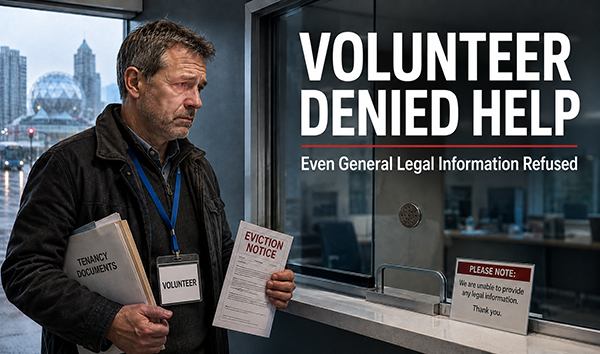
Update — August 12, 2026: Following publication of this article, First United contacted me regarding the article and my volunteer role. The organization informed me that my scheduled volunteer shifts for August 12 and 13 were being reassigned to provide time “for all of us to reflect,” and that it would follow up during the week of August 24. The message did not state that my volunteer status had been suspended or terminated. I have requested written clarification and will fairly report any further response from First United.
A first-person account of what happened when I sought basic help while fighting to keep the home I had lived in for 13 years.
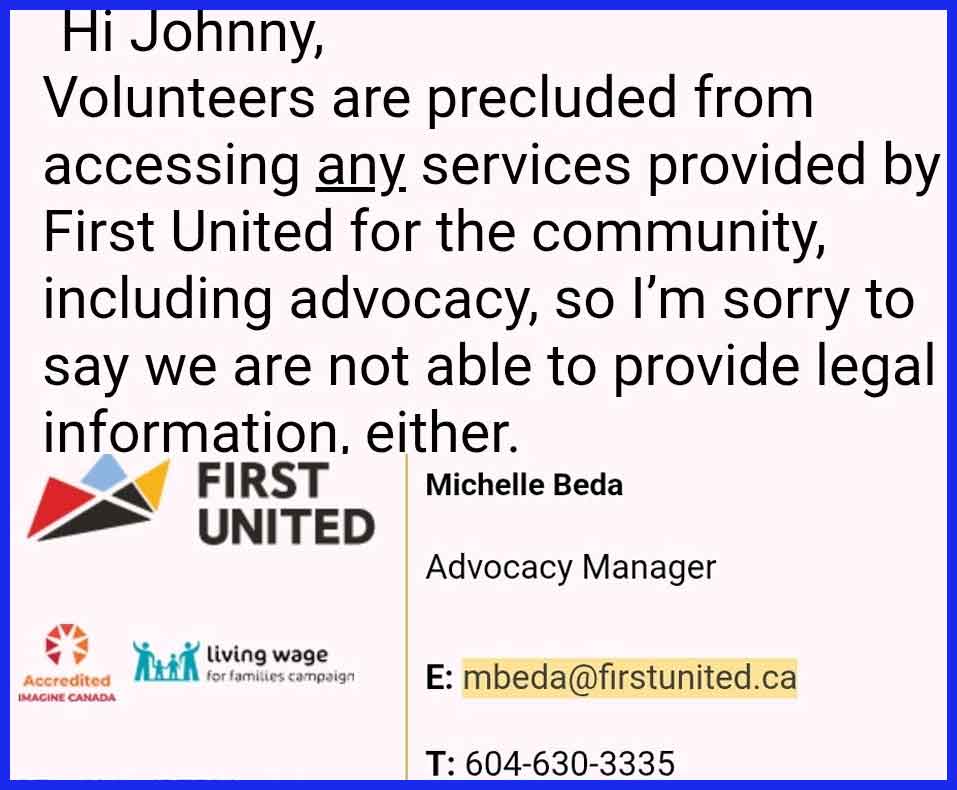
“Volunteers are precluded from accessing any services provided by First United for the community, including advocacy, so I’m sorry to say we are not able to provide legal information, either.”
Those words were written to me on August 11, 2026, b
y Michelle Beda, Advocacy Manager at First United Church Community Ministry Society in Vancouver.
They are the heart of this story.
I had not asked Michelle Beda to represent me. I had not asked First United to enter a solicitor-client relationship or take a position in a dispute involving the organization.
After being told that its legal clinic could not assist me because I was a volunteer, I asked a very narrow follow-up question: could I still obtain general legal information if First United was clearly not representing me?
Michelle Beda’s written answer was no.
Not simply no representation. Not simply no individualized legal advice. According to her email, volunteers are excluded from any services First United provides to the community, including even general legal information.
In my opinion, that is heartless. Given the breadth and timing of the refusal, I experienced it as malicious in effect and as an example of bad-faith administration.
I cannot know Michelle Beda’s private thoughts or prove a private motive, and I do not claim that I can. My opinion is based on the conduct documented in the emails: I expressly distinguished general information from representation, and she expressly refused it anyway.
A volunteer confronting possible homelessness
I am a Vancouver tenant living on disability assistance. I had lived in the same subsidized home for 13 years when a serious dispute developed with my non-profit housing provider.
My longstanding rent had been $340 per month. Following a disputed subsidy review, my housing provider took the position that the rent should become $1,545. I challenged that amount and the documentation demands behind it.
While a related Residential Tenancy Branch decision was pending, I received a 10-Day Notice to End Tenancy on July 27. The deadline to dispute it was August 4.
Missing that deadline could have put my home—and potentially my ability to avoid homelessness—at immediate risk.
I turned to First United’s Legal Advocacy Clinic. This appeared to be precisely the kind of crisis the clinic publicly says it handles. First United’s website says its advocates assist low-income and vulnerable people with eviction disputes and tenancy matters. It begins its description of the clinic by declaring that everyone deserves access to justice. (First United Legal Advocacy)
Before my appointment, a First United advocate requested my tenancy agreement and documents from my landlord. I supplied them. I planned to bring my case file and computer to an in-person appointment on August 4 so I could receive help with the urgent filing.
August 4 was the last possible filing day.
That day, I was informed that First United could not assist me because I volunteered with the organization.
I ultimately completed and filed the RTB application myself before the deadline, and it was accepted. But that does not excuse what happened. An urgent legal clinic should screen for a categorical exclusion before requesting confidential documents and allowing an appointment to land on a client’s final filing day.
Michelle Beda confirms the blanket refusal
Michelle Beda subsequently wrote to confirm First United’s position. She apologized, said my documents would remain confidential, and offered to contact the Tenant Resource & Advisory Centre and Access Pro Bono. I authorized those referrals.
I credit her for taking those steps. TRAC was unable to assist, while an Access Pro Bono response was still pending.
But a referral attempt does not erase the central problem.
I asked Michelle whether, despite the representation restriction, I could still ask general legal questions. My email specifically stated:
“Of course, you’re not representing me when you give me general information.”
Her answer was that volunteers could not access any community services, so First United could not provide legal information either.
This distinction matters enormously.
A conflict policy may justify declining a retainer or referring an individual case elsewhere. But handing someone publicly available information, explaining a general RTB procedure, or identifying an applicable resource does not necessarily require representation.
If First United believes even those neutral acts create an unacceptable conflict, it should disclose the exact written policy and explain its reasoning. It should also explain why the restriction apparently reaches every community service, not merely its legal clinic.
Why I call the conduct heartless and bad faith
Words such as “heartless,” “malicious,” and “bad faith” should not be used casually. Here is the factual foundation for my opinion:
- I was a low-income person with a disability confronting a possible eviction after 13 years in my home.
- First United knew I had an urgent tenancy matter and requested my legal documents.
- My in-person appointment took place on the final filing day.
- Only then was the volunteer exclusion enforced.
- I later narrowed my request to general information and expressly acknowledged that no representation would exist.
- Michelle Beda still refused, citing a policy barring volunteers from any community service.
- No copy of the policy or proportionate explanation accompanied that refusal.
I cannot state as fact that Michelle Beda intended to harm me.
But I can state that, in my honest opinion, refusing even general information in these circumstances was heartless; that the exclusion felt malicious in its effect; and that applying it only after documents were collected and a deadline arrived appeared inconsistent with good faith.
Readers can see the documented facts and decide whether they agree.
A striking contradiction
First United describes itself as a low-barrier organization that advocates for dignity, belonging, and justice. It says it welcomes people from all walks of life. It has also publicly explained that its advocacy work helps people avoid eviction and remain in their homes. (First United homepage; The 100-Year Dream for Advocacy)
The organization publicly praises volunteers for strengthening its work. Yet the policy communicated by Michelle Beda appears to mean that volunteering can remove a person from the entire community First United serves. (First United volunteer recognition)
That is not a minor administrative technicality.
Volunteers are not necessarily wealthy or protected from hardship. Many volunteer precisely because they understand poverty, disability, housing insecurity, or social isolation personally.
A charity should not accept their labour without clearly warning them that doing so may disqualify them from every service if their own life enters crisis.
What First United and Michelle Beda should answer
I am asking First United and Michelle Beda to answer several straightforward questions:
- Where is the complete written policy, and when was it adopted?
- Why does it prohibit general information rather than only representation or individualized advice?
- Why does it apparently exclude volunteers from all community services?
- Why was I not screened before First United requested my documents and scheduled an appointment on my deadline?
- Can a volunteer resign and regain eligibility, and is there a waiting period?
- Is there any urgent exception for eviction, benefits termination, or imminent homelessness?
- Did Michelle Beda have discretion over her refusal, or was she communicating someone else’s decision?
First United’s published complaints policy says complaints about staff action or inaction can be treated as service complaints, while policy objections are treated as non-service complaints. It also says complaints should help the organization become more accountable, fair, and committed to continuous improvement. (First United Complaints Policy)
This case requires both forms of review.
The intake failure concerns what happened to me. The blanket volunteer exclusion concerns everyone who donates time to First United without understanding what that service may cost them later.
I managed to protect my RTB deadline without First United. The next volunteer may not.
No person should learn during an eviction crisis that helping a charity has disqualified him not only from legal representation, but even from receiving general information.
Michelle Beda put that position in writing. First United’s leadership must now decide whether it is prepared to defend it publicly.
Editor’s note: This is a first-person opinion article based on correspondence dated August 4 and August 11, 2026. Michelle Beda and First United are invited to respond. Any substantive response should be published or fairly summarized in an update.